


Th6: TCM's Governing Vessel Ally
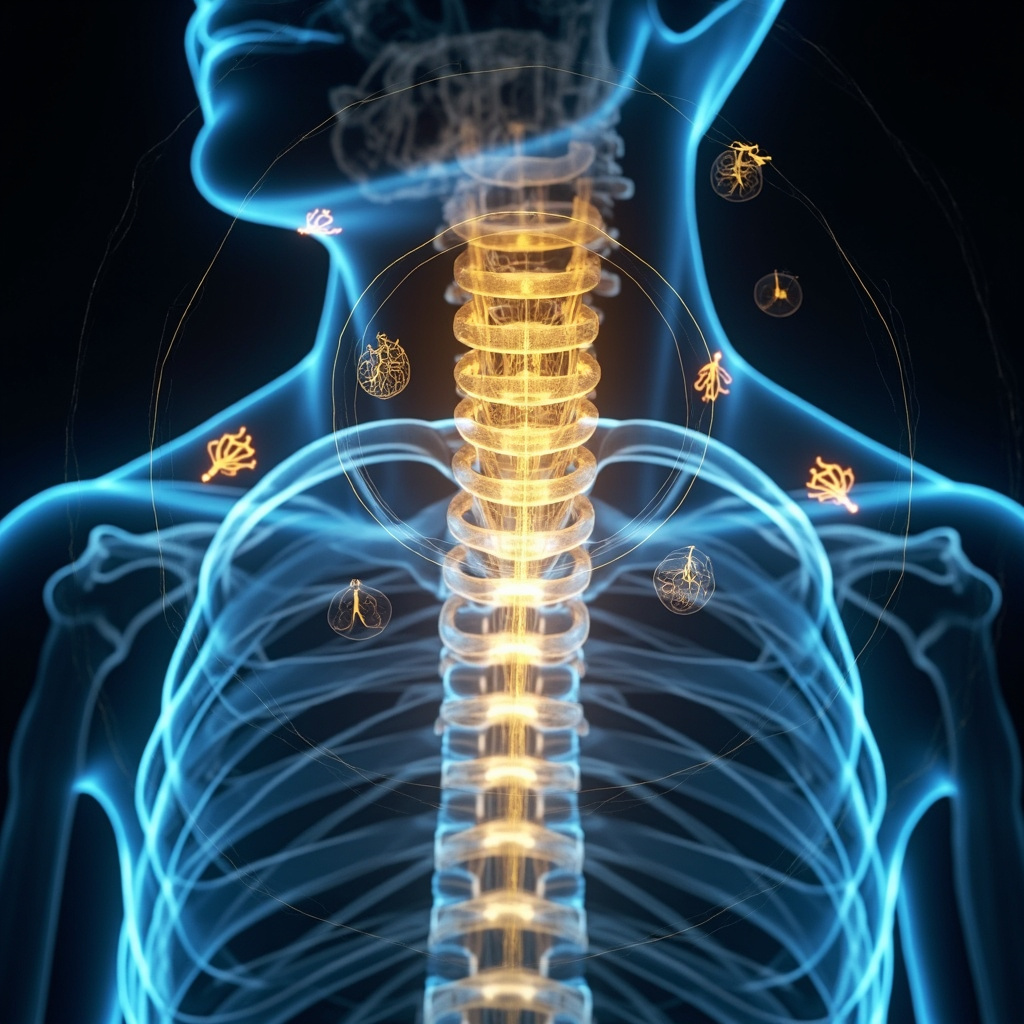
Where Th6 Resides in Your Body
The sixth thoracic vertebra, known as Th6, forms part of the middle spine. Picture it just below your shoulder blades, nestled among the 12 thoracic bones that form a protective cage around your vital organs. This sturdy structure supports the rib cage while shielding the spinal cord, the highway for nerve signals traveling between your brain and body.
Th6 helps with smooth movements in the upper back and chest. It ensures nerves reach areas like the stomach and pancreas effectively. For more details, see the Th6 glossary.
Key Functions of Th6
Physically, Th6 plays a vital role:
- Protects the spinal cord: Acts as a shield for delicate nerves.
- Supports posture and mobility: Enables twisting, bending, and breathing without strain.
- Transmits signals to organs: Influences upper abdomen functions, like digestion in the stomach and blood sugar balance via the pancreas.
Healthy Th6 means better coordination between your upper body and core organs. Issues here, such as misalignment or strain, can pinch nerves, leading to mid-back pain or digestive discomfort like heartburn.
Th6 in Traditional Chinese Medicine
In Traditional Chinese Medicine (TCM), the spine is the backbone of energy flow, home to the Governing Vessel or Du Mai. This central meridian runs along the back, regulating yang qi – the active, warming energy that drives strength, coordination, and vitality.
At the Th6 level lies BL16, the back-shu point for the Governing Vessel. Shu points are like control centers: tender spots signal imbalances in linked systems. Here, Th6 influences:
- Yang harmony: Boosts overall drive and resilience.
- Organ support: Near points for heart (T5) and diaphragm (T7), it aids chest and breath functions.
- Qi circulation: Clears blockages in meridians tied to fire (heart) and earth (spleen/stomach) elements.
TCM sees spine health as key to emotional balance too. Stagnant qi at Th6 might show as worry over control or low energy, echoing spleen/stomach patterns of overthinking.
Signs of Imbalance at Th6
When Th6 falters, symptoms arise:
- Physical: Upper back stiffness, chest tightness, indigestion, or pancreas-related fatigue.
- Emotional: Restlessness, lack of direction, or weakened resolve – signs of yang deficiency.
- Energy: Blocked qi flow disrupts sleep, immunity, or daily vigor.
Modern views align: nerve compression at Th6 can mimic these, causing pain radiating to the gut or reduced mobility.
Harnessing Th6 as a Resource
A strong Th6 empowers your body:
- Enhances nerve transmission to heart, lungs, and digestion for better organ teamwork.
- Promotes upper body balance, easing breath and movement.
- Supports emotional steadiness through steady yang flow.
In practice, TCM uses this insight with biomarkers from body electrical readings. These reveal Th6's energy levels, agitation, and ties to other systems. Balanced frequencies resonate with its natural vibrations, fostering harmony.
As a resource, Th6 guides inner work: invite it to anchor your posture, circulate qi, and vitalize organs. Simple steps include gentle stretches targeting the mid-back, breathwork to engage the diaphragm, or meridian walks along the spine.
Pathways to Harmony
Restore Th6 through:
- Acupressure: Press BL16 gently, 1.5 thumb-widths from spine midline at Th6 level.
- Breath focus: Deep belly breathing to nourish spleen/stomach qi.
- Movement: Tai chi flows that strengthen the back channel.
By aligning Th6, you unlock smoother energy flow, blending ancient wisdom with body signals for whole-person health.
- 1. digital-clinics.com
- 2. myositis.org
- 3. prnewswire.com
- 4. researchgate.net
- 5. sciencedirect.com
- 6. facebook.com
- 7. pmc.ncbi.nlm.nih.gov
- 8. ucihealth.org
- 9. bibliosjd.org
- 10. integrativehealthcare.org
- 11. meandqi.com
- 12. finance.yahoo.com
- 13. youtube.com
- 14. deukspine.com
- 15. med-vetacupuncture.org
- 16. pmc.ncbi.nlm.nih.gov
- 17. peaksandpointsacup.com
- 18. pmc.ncbi.nlm.nih.gov
- 19. nature.com
- 20. chiro.org
- 21. palmerdmd.com
- 22. finepointacupuncture.com
- 23. pmc.ncbi.nlm.nih.gov
- 24. pmc.ncbi.nlm.nih.gov
- 25. healthline.com
- 26. journals.lww.com
- 27. link.springer.com
- 28. reddit.com
- 29. youtube.com
- 30. youtube.com
- 31. pmc.ncbi.nlm.nih.gov
- 32. sportsmedicineacupuncture.com
- 33. youtube.com
- 34. pmc.ncbi.nlm.nih.gov
- 35. youtube.com
- 36. carenewengland.org
- 37. beckersspine.com
- 38. lcm.amegroups.org
- 39. mdpi.com
- 40. shamtam.com
- 41. rankings.newsweek.com
- 42. academia.edu
- 43. youtube.com
- 44. neurospinefl.com
- 45. youtube.com
- 46. pmc.ncbi.nlm.nih.gov
- 47. pmc.ncbi.nlm.nih.gov
- 48. pmc.ncbi.nlm.nih.gov
- 49. med-vetacupuncture.org
- 50. massagetherapy.com
- 51. sciencedirect.com
- 52. brooklynpaindoctors.com
- 53. open.spotify.com
- 54. youtube.com
- 55. sitcm.edu.au
- 56. pmc.ncbi.nlm.nih.gov
- 57. doppschiropracticop.com
- 58. austinpublishinggroup.com
- 59. ojaischoolofmassage.com
- 60. sportsmedicineacupuncture.com
- 61. pmc.ncbi.nlm.nih.gov
- 62. acumed.org
- 63. morningsideacupuncturenyc.com
- 64. elementtherapeutics.ca
- 65. pmc.ncbi.nlm.nih.gov
- 66. katokamassagetherapy.com
- 67. smallingclinic.com
Related posts
Glossary
- Energy and mind Structures > Structure
- Energy and mind Structures > Earth
- Energy and mind Structures > Fire
- Energy and mind Structures > Drive
- Energy and mind Structures > Drives
- Energy and mind Structures > Immunity
- Energy and mind Structures > Meridians
- Body zones > bones
- Body zones > lungs
- Body zones > nerves
- Body zones > Th6
- Body zones > chest
- Energy and mind Structures > Organs
- Energy and mind Structures > BL16
- TCM Recipes > Emotional Balance: A TCM Guide to Calm Anxiety & Insomnia
- TCM Recipes > Pancreas Health: Improve Digestion and Blood Sugar Balance
- TCM Recipes > Digestive Relief: A Simple Guide to Ease Bloating & Indigestion
- TCM Recipes > Heartburn Relief: A Simple TCM Recipe for Comfort
- TCM Recipes > Stomach Health: Natural Remedies for Digestive Issues
- TCM Recipes > Heart Health: Remedies for Anxiety and Palpitations
- TCM Recipes > Brain Boost: Clear Fog, Improve Focus & Memory
- TCM Recipes > Boost Your Energy: A TCM Recipe for Fatigue Relief
- Energy and mind Structures > sleep
- Energy and mind Structures > vitality
- Energy and mind Structures > movement
- Energy and mind Structures > Digestion
- Energy and mind Structures > Vital organs
- Stimuli > Indigestion
- Stimuli > Moon - Nasal Passage, Breathing, Taste
- Stimuli > AIDS
- Stimuli > Pain
- Binaural beats > Spinal Cord Support: Enhance Wellness and Emotional Balance
- Stimuli > Harmony
- Stimuli > Blood
see also...
- Energy and mind Structures > Vital organs
- Energy and mind Structures > Body zones > substantia nigra
- Energy and mind Structures > TCM Recipes > Tension Headache Relief: A Natural Approach to Ease Stress
- Testimonials > 61% Drop in Nausea and 58% in Headaches from Sound Therapy
- Binaural beats > Stimuli > Variolinum
- Binaural beats > Spinal Cord Support: Enhance Wellness and Emotional Balance