


Sacrum: Yoga for Stability & Support
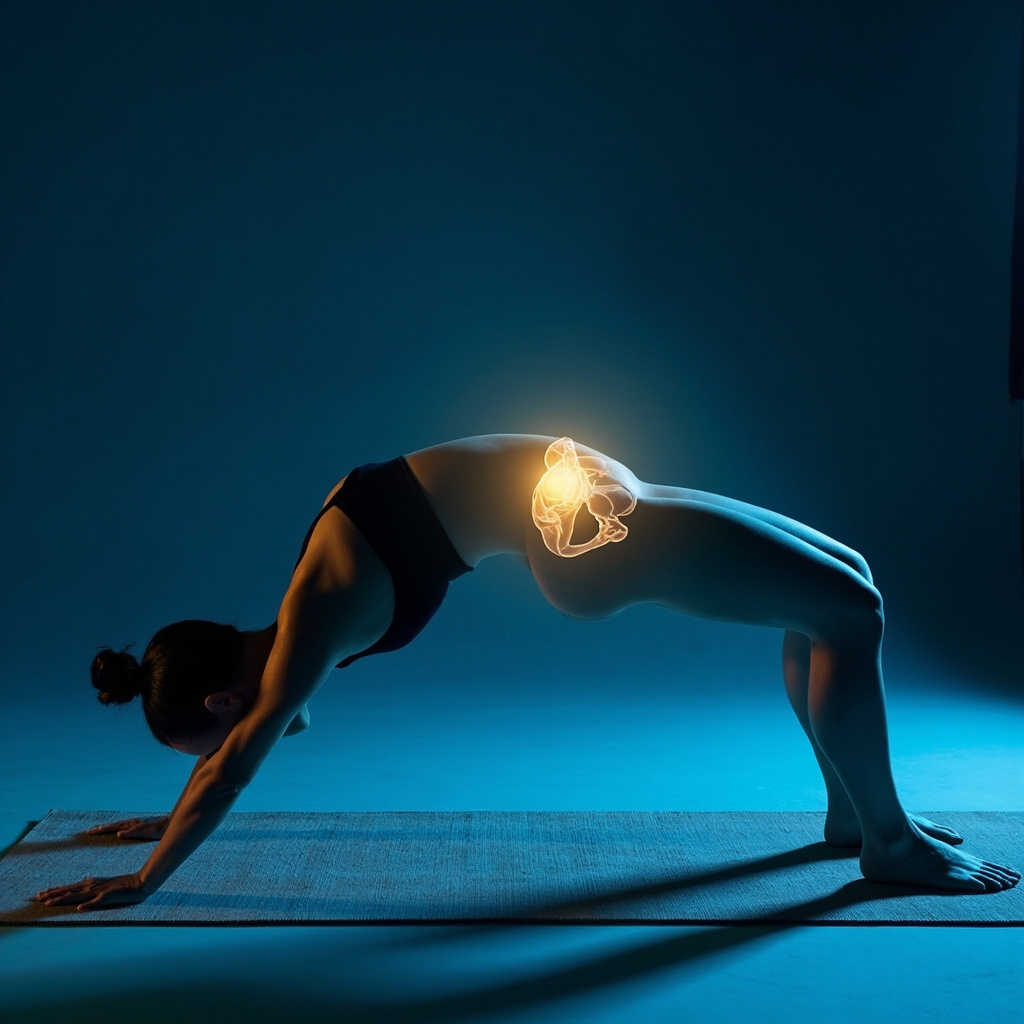
The Sacrum: Foundation of Your Body
Your sacrum is a strong, triangular bone at the base of your spine. It forms the back wall of your pelvis and connects your spine to your hip bones through the sacroiliac joints. See the glossary entry for more details.
This bone bears the weight of your upper body when you stand or move. It gives your pelvis stability and strength, helping you walk, sit, and bend with ease. A healthy sacrum keeps your posture aligned and your movements fluid.
Signs of Sacrum Imbalance
When the sacrum is out of balance, you might feel lower back pain, sciatica (sharp pain down the leg), or trouble with mobility. Everyday activities like standing too long or poor posture can strain it. Tight hips or weak core muscles often make things worse.
Recent studies highlight how common this is. For example, sacroiliac joint issues contribute to 15-30% of chronic low back pain cases. Yoga therapy has shown promising results, reducing pain and improving daily function in people with related lower back problems.
Emotional Links to the Sacrum
Beyond the physical, the sacrum ties to feelings of support and grounding. If you feel insecure, burdened by responsibilities, or unsupported in life, tension can build here. Emotional stress or fear of instability might show up as physical discomfort.
Working with the sacrum through yoga helps release these patterns. It fosters a sense of inner strength, like rooting into solid ground. As a resource, the sacrum supports other body parts by transmitting steady energy, improving overall alignment and easing stress.
Yoga Practices to Strengthen Your Sacrum
Yoga restores balance by targeting the muscles around the sacrum-glutes, hips, lower back, and core. Focus on poses that build strength, stretch gently, and promote awareness. Start slow, breathe deeply, and stop if pain sharpens.
Practice 3-5 times a week for 10-20 minutes. Use a mat and props like blocks or blankets for comfort.
1. Cat-Cow Pose (Marjaryasana-Bitilasana)
- Benefits: Warms the spine, increases hip and lower back mobility, eases sacrum tension.
- How: On hands and knees, wrists under shoulders, knees under hips. Inhale, arch your back, lift head and tailbone (Cow). Exhale, round spine, tuck chin (Cat). Flow 5-10 breaths.
2. Downward-Facing Dog (Adho Mukha Svanasana)
- Benefits: Stretches hamstrings, calves, and back; strengthens shoulders and core for sacrum support.
- How: From hands and knees, tuck toes, lift hips into an inverted V. Press heels down, chest toward thighs. Hold 3-5 breaths, repeat 3 times.
3. Bridge Pose (Setu Bandhasana)
- Benefits: Strengthens glutes, lower back, and hips; stabilizes sacroiliac joints.
- How: Lie on back, knees bent, feet flat hip-width. Inhale, lift hips, squeeze glutes. Keep shoulders down. Hold 3-5 breaths, lower slowly. Repeat 3 times.
4. Pigeon Pose (Eka Pada Rajakapotasana, modified)
- Benefits: Opens deep hip muscles like piriformis, relieves sacrum pressure.
- How: From all fours, bring right knee forward behind wrist, extend left leg back. Fold forward gently. Hold 5 breaths per side.
5. Legs-Up-the-Wall (Viparita Karani)
- Benefits: Neutralizes pelvis, reduces swelling, calms nervous system.
- How: Sit sideways to wall, swing legs up. Scoot hips close. Relax 5-10 minutes.
Breathing for Deeper Support
Pair poses with pranayama (breath work). Try Nadi Shodhana: Close right nostril, inhale left; close left, exhale right. Alternate 5 rounds. This balances energy, reduces stress affecting the sacrum.
Building a Routine
- Warm-up: 5 minutes Cat-Cow and gentle twists.
- Main sequence: Bridge, Downward Dog, Pigeon (both sides).
- Cool down: Legs-Up-the-Wall, Savasana (corpse pose) with knees supported.
Track progress: Notice less pain, better posture, and emotional ease. For personalization based on your body's signals, consult a yoga therapist.
Consistent practice turns the sacrum into a reliable anchor, enhancing vitality and resilience. Embrace movement as medicine for body and mind.
- 1. facebook.com
- 2. dogwoodstudioyoga.com
- 3. painteq.com
- 4. si-bone.com
- 5. yogaselection.com
- 6. beneyoga.co.uk
- 7. yogajournal.com
- 8. health.harvard.edu
- 9. youtube.com
- 10. romanomd.com
- 11. rapm.bmj.com
- 12. npr.org
- 13. yogainternational.com
- 14. garnerpelvichealth.com
- 15. insighttimer.com
- 16. youtube.com
- 17. theyogatherapyinstitute.org
- 18. hermanwallace.com
- 19. youtube.com
- 20. yogajournal.com
- 21. spine-health.com
- 22. floridaortho.com
- 23. pubmed.ncbi.nlm.nih.gov
- 24. youtube.com
- 25. essentialsportsspine.com
- 26. yogawithlillah.com
- 27. instagram.com
- 28. youtube.com
- 29. youtube.com
- 30. bannerhealth.com
- 31. newsinhealth.nih.gov
- 32. youtube.com
- 33. yogauonline.com
- 34. viniyoga.com
- 35. healthcentral.com
- 36. pmc.ncbi.nlm.nih.gov
- 37. facebook.com
- 38. yogainternational.com
- 39. medicalnewstoday.com
- 40. pmc.ncbi.nlm.nih.gov
- 41. yogabody.com
Related posts
Glossary
- Energy and mind Structures > Focused Coherence; Focus
- Energy and mind Structures > Relax
- Body zones > head
- Body zones > bones
- Body zones > joints
- Body zones > sacrum
- Body zones > muscles
- Body zones > chest
- TCM Recipes > Chronic Low Back Pain: Relief for Stiffness & Spasms
- TCM Recipes > Back Pain Relief: Easy Remedies for Sciatica & Stiffness
- Energy and mind Structures > vitality
- Energy and mind Structures > movement
- Energy and mind Structures > Stress
- Stimuli > Moon - Nasal Passage, Breathing, Taste
- Stimuli > Pain
- Binaural beats > Nervous System: A Program for Emotional Balance and Relaxation
- Stimuli > Bone
see also...
- Energy and mind Structures > HRV
- Energy and mind Structures > Body zones > substantia nigra
- Energy and mind Structures > TCM Recipes > Back Pain Relief: Easy Remedies for Sciatica & Stiffness
- Testimonials > 61% Drop in Nausea and 58% in Headaches from Sound Therapy
- Binaural beats > Stimuli > Bone
- Binaural beats > Transmutation: A Sound Journey for Personal Change